A night sky you go out and seeNEW
A night sky you go out and see: Byeolmuri
What you learn on screen, you confirm in the sky that same night.
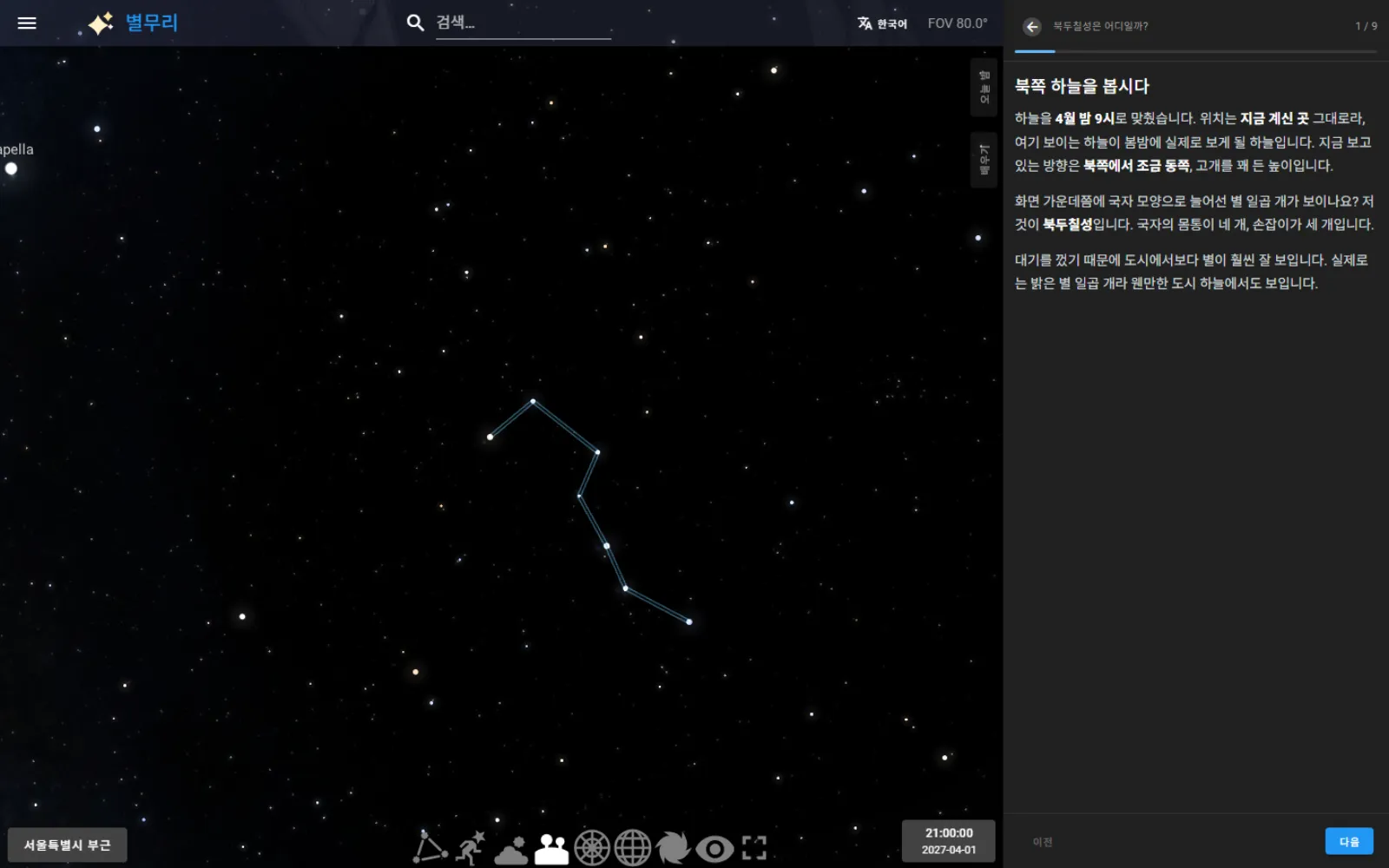
Byeolmuri teaches the constellations and how the night sky works, in 19 lessons of 162 steps. Every time the text moves on a step, the sky on screen moves with it — the way a teacher turns the dome at an observatory. It reads in Korean, English, Japanese and Spanish.
It opens straight in a web browser. No install, no sign-up, no ads and no tracking. The sky is drawn for wherever you are, using your location.
What you can do
The text and the sky move together
19 lessons, 162 steps. Each step sets the date, time and direction of the sky to match what is being said, and circles the star under discussion. 38 quizzes along the way check that it landed.
The real sky above you
Not a drawing — a sky drawn from real astronomical calculation. Star positions, the shape of the Moon, where the planets sit: all correct for your place and time. What you see on screen is what is outside.
What to look at tonight
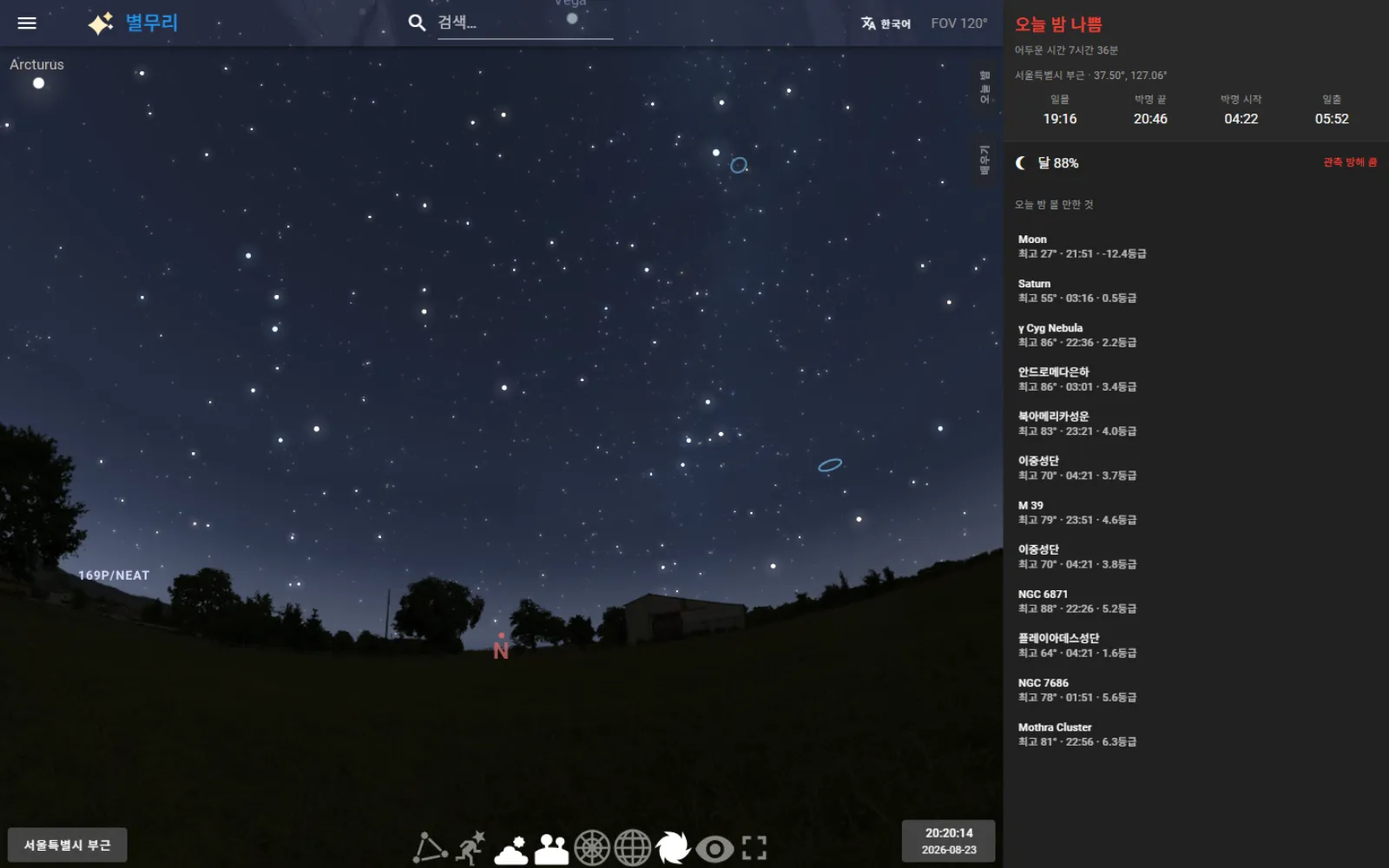
When the Sun sets and when the sky goes fully dark, how much the Moon will get in the way, and which objects ride high tonight. It reads the short-term forecast too, so you can see the clouds coming.
Every lesson ends outdoors
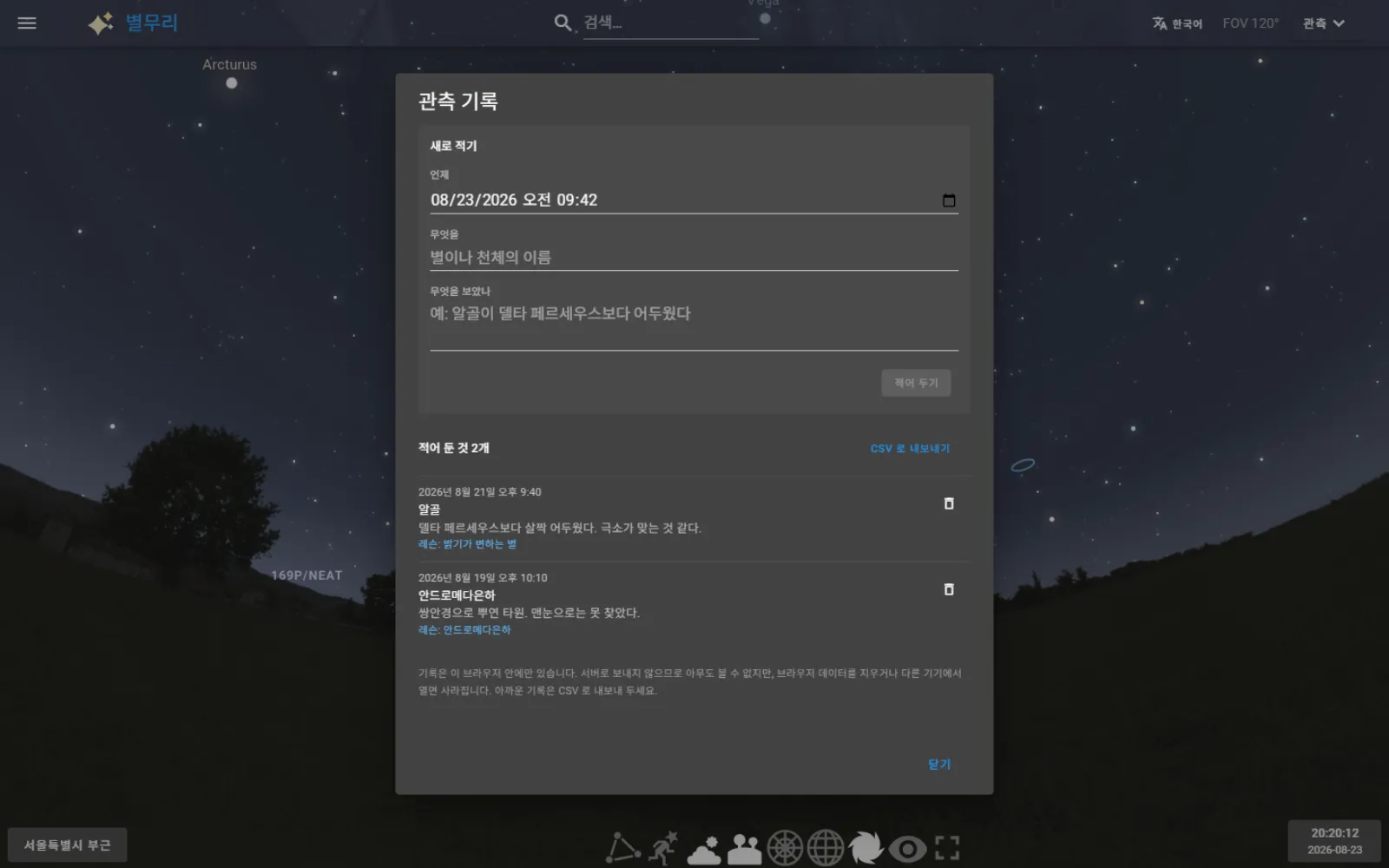
All 19 lessons end with "go out tonight and try this." What you see goes in the observation log, and the log exports to CSV.
What the 19 lessons cover
They fall into three tracks. Read them in order, or pick whichever suits tonight’s sky.
How it works — why the sky looks like that
Why the constellations change with the season, why the Moon changes shape, eclipses of the Sun and Moon, why planets go backwards, how latitude changes the sky, and why the pole star is not forever. Eight lessons.
What to find — where to point your eyes
The Big Dipper, the Summer Triangle, the Andromeda Galaxy, the Orion Nebula, the Pleiades, the Spring Arc. How to find each one and what it actually is. Six lessons.
How we know — the measuring
Magnitude, the colour and temperature of stars, how a distance to a star is measured, the proper motion that slowly pulls constellations apart, and stars that change brightness. Five lessons on how people worked it out.
Recent updates
Three additions to the menu
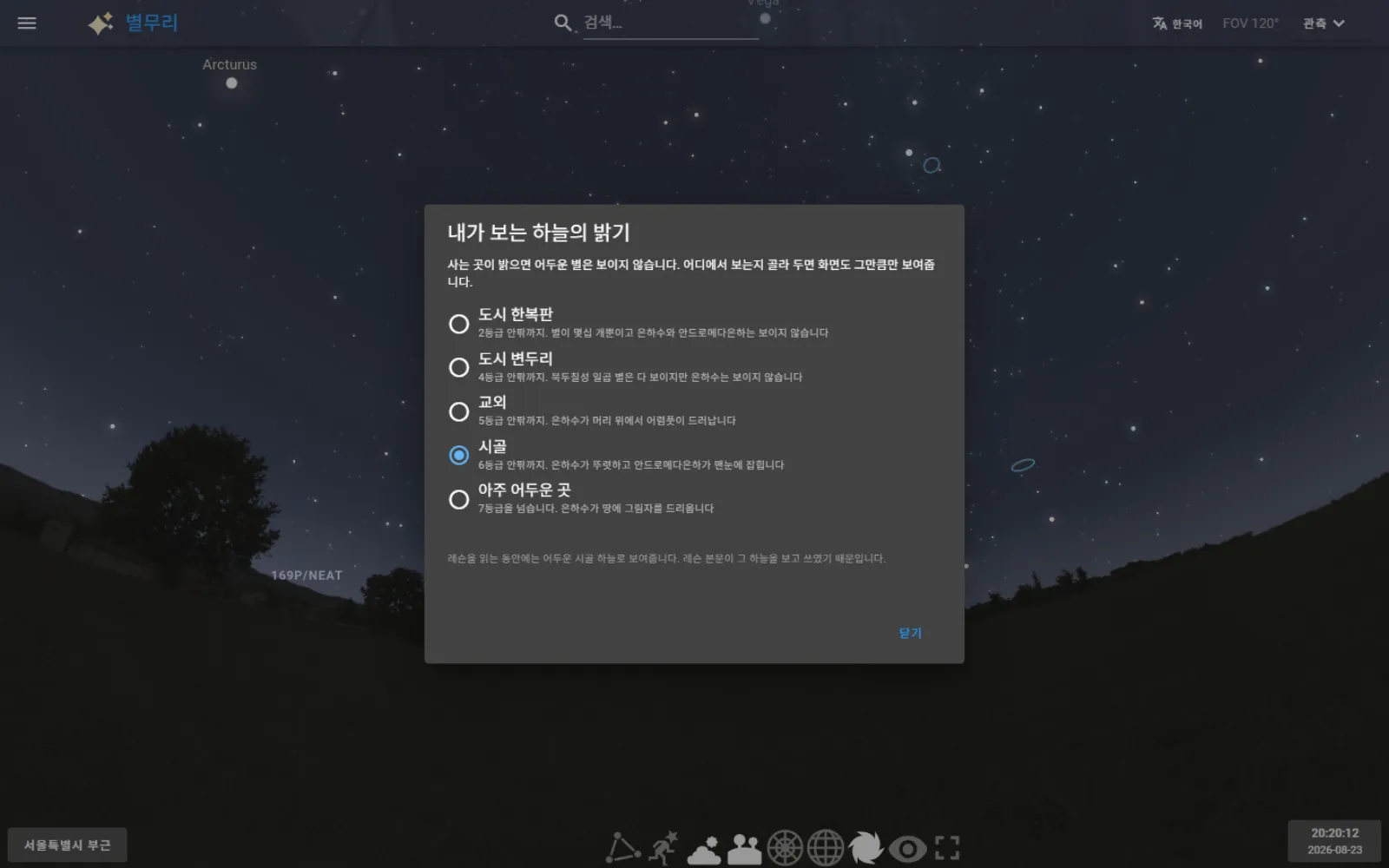
Sky Brightness thins out the stars on screen to match the light where you live. What’s Up gathers the next two months of events. The Observation Log is where what you saw outside goes.
English, Japanese and Spanish
All 19 lessons are now translated into three languages. Anything not yet translated falls back to Korean — and says on screen that it is doing so.
Three new lessons, and a review applied
Meteor showers, proper motion and variable stars brought the count to nineteen. Factual errors and places where the text disagreed with the screen, found in an outside review, are fixed.
The lesson list and the front page
The front page opens light because it does not start the sky engine. It shows the lessons you can see tonight first, then all nineteen below with their track, level and how long they take.
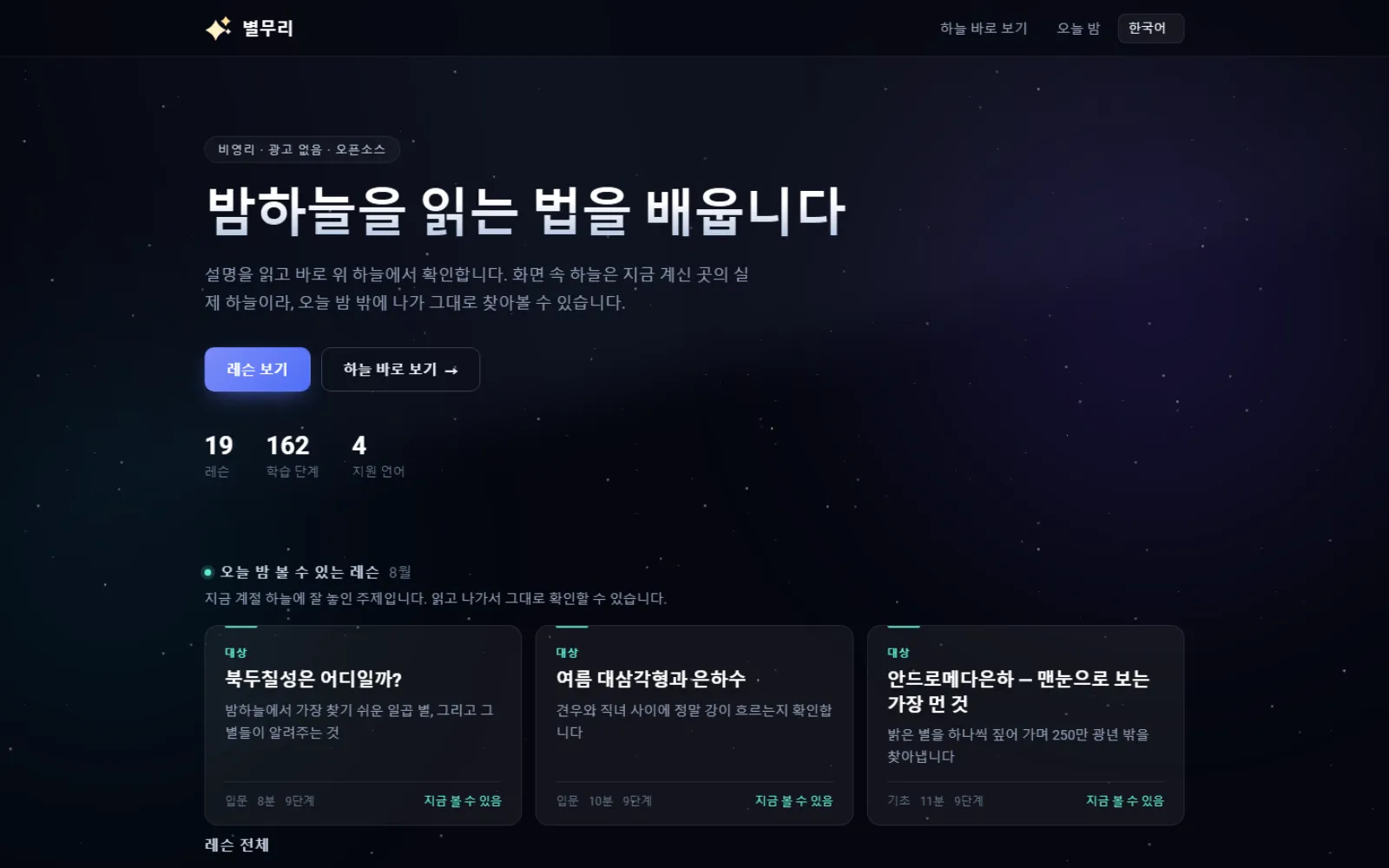
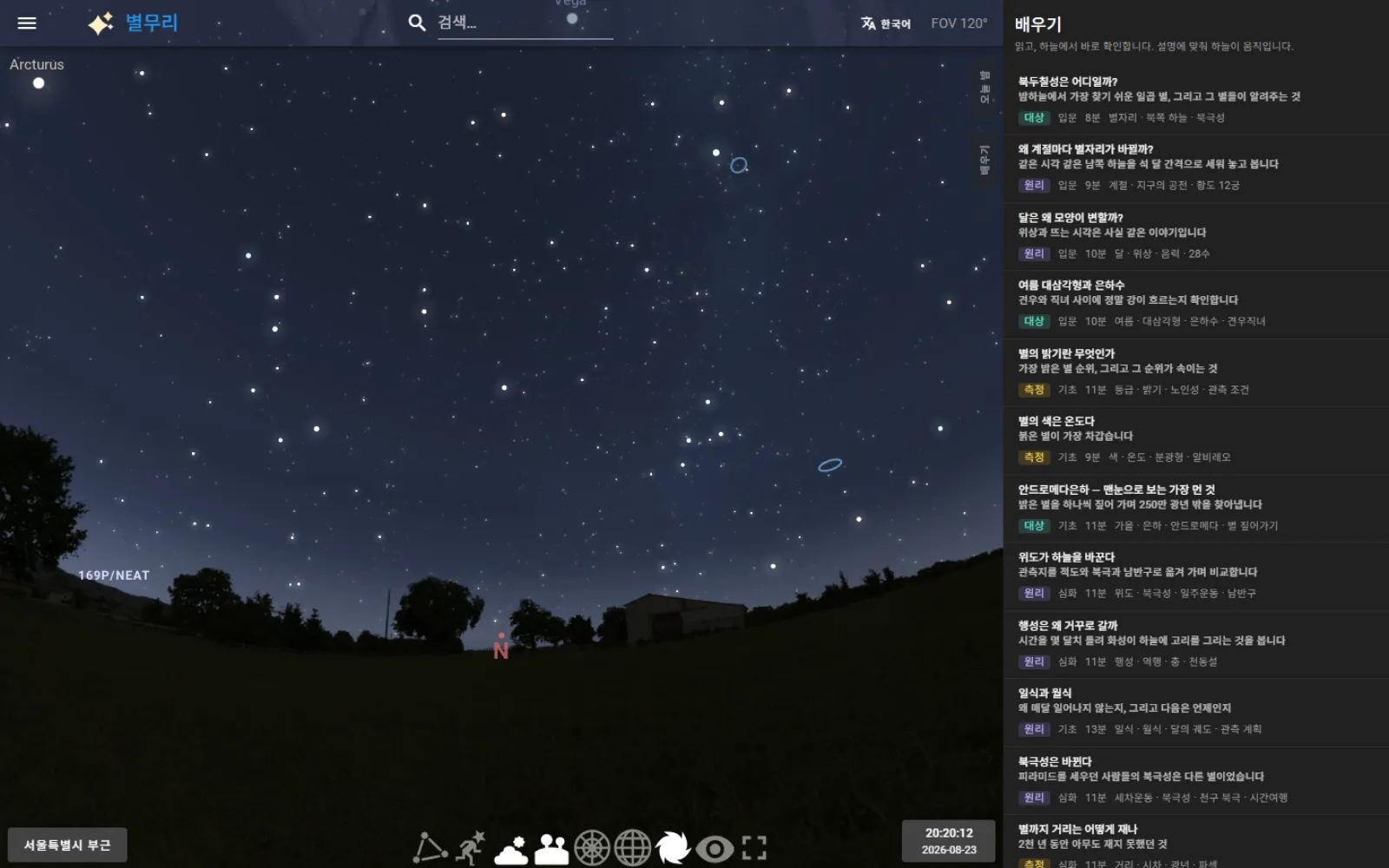
Tonight, and this month
Tonight covers today from sunset to sunrise. What’s Up gathers the next two months: meteor showers, the phases of the Moon, planets at opposition and the nights they draw close to each other. Each entry links straight to the lesson about it.
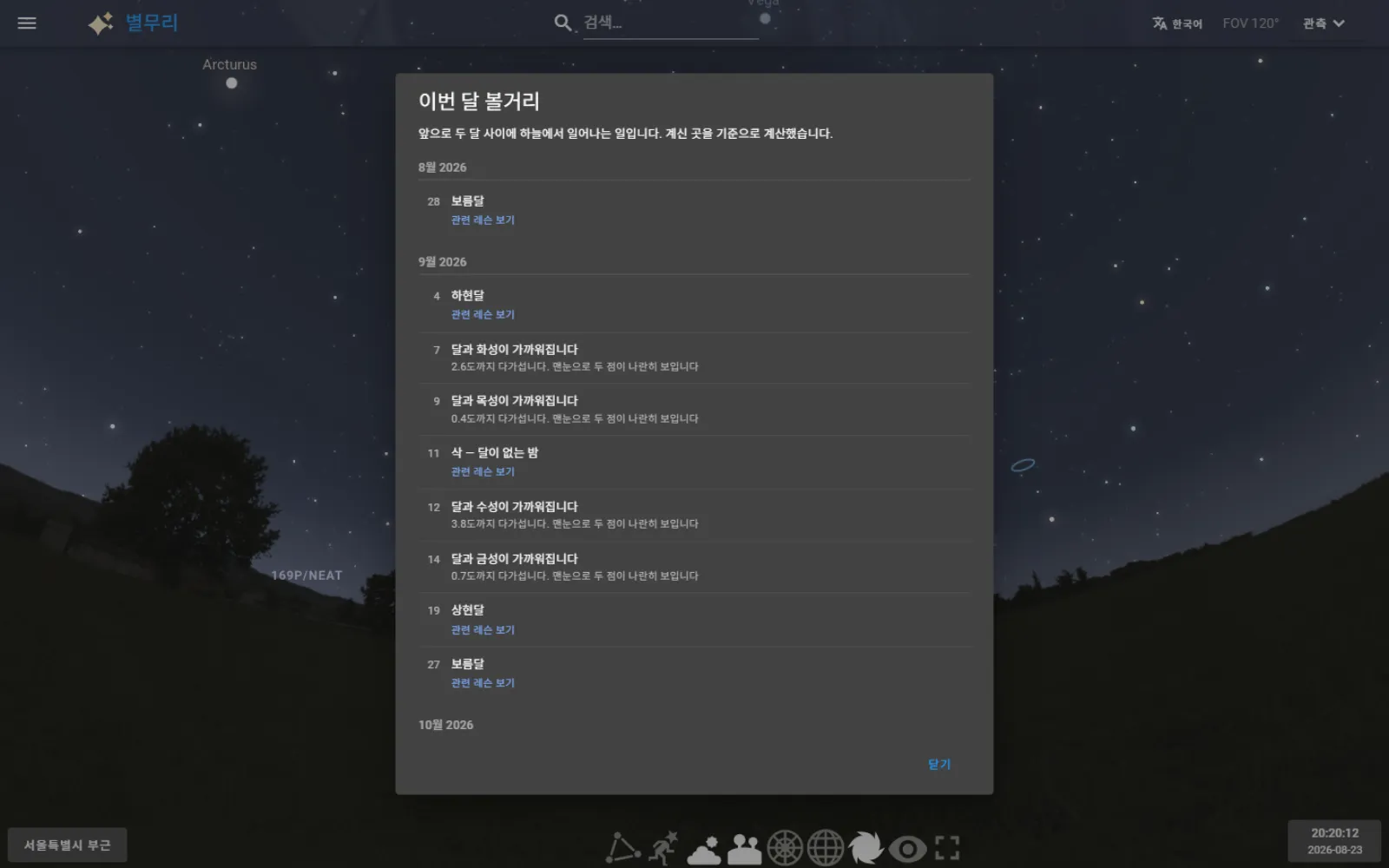
Match your own sky, and keep what you saw
Sky Brightness takes where you live and shows only as much as you would really see there — so a city dweller does not go out expecting a country sky and find nothing. The Observation Log is where what you saw goes.
Byeolmuri is a non-profit open source project built on the Stellarium Web Engine, and is not affiliated with the official Stellarium project or with Stellarium Labs. Star data comes from the Gaia and Hipparcos catalogues; nebula and galaxy data from HyperLeda and OpenNGC.
Scratch for Children is based on ScratchJr by the MIT Media Lab, Arcade Teading on Microsoft MakeCode Arcade, and Nudge on PhET Interactive Simulations from the University of Colorado Boulder. Learning samples were built using content from BootUp.